Understanding Ohm's Law and Its Application to Passive Circuit Elements
- DAGBO CORP
- Apr 6
- 4 min read

Electric circuits form the backbone of modern technology, powering everything from household appliances to complex industrial machines. At the heart of understanding these circuits lies a fundamental principle known as Ohm's law. This law explains the relationship between voltage, current, and resistance, especially at the terminals of passive elements like resistors, capacitors, and inductors. Grasping this concept is essential for anyone working with or studying electrical circuits.
This post explores Ohm's law in detail, focusing on how it applies to passive circuit elements. It breaks down the theory, practical applications, and examples to help you understand how voltage and current behave in real-world circuits.
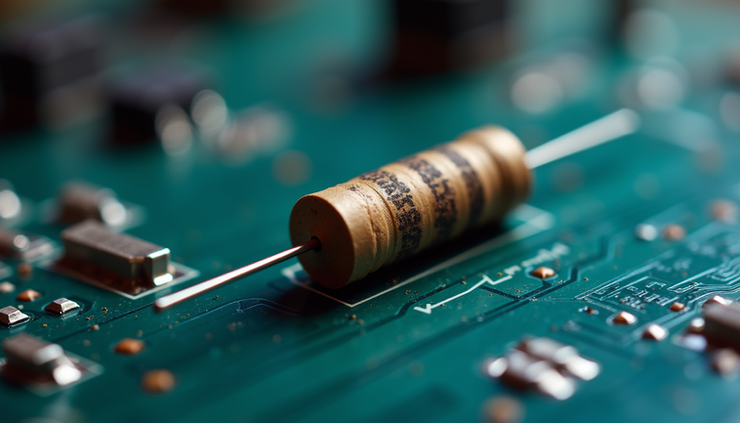
Resistor on a circuit board showing voltage and current flow
What Is Ohm's Law?
Ohm's law is a simple yet powerful rule in electrical engineering. It states that the voltage (V) across a conductor is directly proportional to the current (I) flowing through it, with resistance (R) as the constant of proportionality. The formula is:
V = I × R
Voltage (V) is the electrical potential difference measured in volts.
Current (I) is the flow of electric charge measured in amperes.
Resistance (R) is the opposition to current flow measured in ohms (Ω).
This law applies primarily to passive elements, which do not generate energy but only consume or store it. Resistors are the most straightforward example, but capacitors and inductors also follow related principles when considering voltage and current at their terminals.
Passive Circuit Elements Explained
Passive elements are components that do not produce energy but influence the flow of electrical energy in a circuit. The three main types are:
Resistors: Convert electrical energy into heat, opposing current flow.
Capacitors: Store energy in an electric field, opposing changes in voltage.
Inductors: Store energy in a magnetic field, opposing changes in current.
Each element behaves differently under voltage and current, but Ohm's law provides a foundation for understanding these behaviors.
Applying Ohm's Law to Resistors
Resistors are the simplest passive elements to analyze using Ohm's law. The voltage across a resistor is proportional to the current through it. For example, if a resistor has a resistance of 100 ohms and a current of 0.02 amperes flows through it, the voltage across the resistor is:
V = I × R = 0.02 A × 100 Ω = 2 volts
This relationship helps engineers design circuits with precise voltage drops and current flows.
Practical Example
Imagine a simple circuit with a 9-volt battery and a resistor of 450 ohms. To find the current flowing through the resistor:
I = V / R = 9 V / 450 Ω = 0.02 A (20 milliamps)
This current value is crucial for selecting components that can handle the expected current without damage.
Ohm's Law and Capacitors
Capacitors behave differently because they store energy rather than dissipate it. The voltage across a capacitor depends on the charge stored, and the current depends on how quickly the voltage changes.
The relationship between voltage and current in a capacitor is:
I = C × (dV/dt)
Where:
I is the current through the capacitor,
C is the capacitance,
dV/dt is the rate of change of voltage over time.
While Ohm's law does not apply directly to capacitors as it does to resistors, understanding voltage and current at the terminals is still essential. In steady-state DC conditions, a capacitor acts like an open circuit, meaning no current flows through it, and the voltage remains constant.
Ohm's Law and Inductors
Inductors store energy in a magnetic field when current flows through them. The voltage across an inductor relates to the rate of change of current:
V = L × (dI/dt)
Where:
V is the voltage across the inductor,
L is the inductance,
dI/dt is the rate of change of current over time.
Like capacitors, inductors do not follow Ohm's law in the simple form used for resistors. Instead, their voltage depends on how quickly the current changes. In steady-state DC, an inductor behaves like a short circuit, allowing current to flow freely with minimal resistance.
Measuring Voltage and Current at Terminals
To apply Ohm's law effectively, it is important to measure voltage and current at the terminals of passive elements accurately. Here are some tips:
Use a multimeter to measure voltage across the component terminals.
Measure current by placing the meter in series with the component.
Ensure the circuit is powered correctly and components are rated for the expected voltage and current.
Take note of transient behaviors in capacitors and inductors, as voltage and current can change rapidly.
Common Mistakes When Using Ohm's Law
Many beginners make errors when applying Ohm's law to passive elements:
Assuming capacitors and inductors behave like resistors under all conditions.
Ignoring the time-dependent nature of voltage and current in capacitors and inductors.
Using incorrect units or mixing up voltage and current measurements.
Overlooking the power rating of resistors, which can lead to overheating.
Understanding these pitfalls helps avoid damage to components and ensures accurate circuit analysis.
Real-World Applications
Ohm's law is used in many practical situations involving passive elements:
Designing voltage dividers with resistors to provide specific voltage levels.
Calculating charging and discharging times of capacitors in timing circuits.
Analyzing inductive loads in motors and transformers.
Troubleshooting circuits by measuring voltage drops and current flows.
For example, in a simple LED circuit, a resistor limits the current to prevent the LED from burning out. Calculating the correct resistor value requires applying Ohm's law based on the LED's voltage and desired current.
Summary of Key Points
Ohm's law relates voltage, current, and resistance in resistors.
Capacitors and inductors have voltage-current relationships involving rates of change.
Measuring voltage and current at terminals is essential for applying Ohm's law.
Understanding the behavior of passive elements prevents common mistakes.
Ohm's law supports practical circuit design and troubleshooting.
By mastering Ohm's law and its application to passive elements, you gain a powerful tool for working with electrical circuits. Whether designing new devices or repairing existing ones, this knowledge helps ensure circuits function safely and efficiently.


Comments